
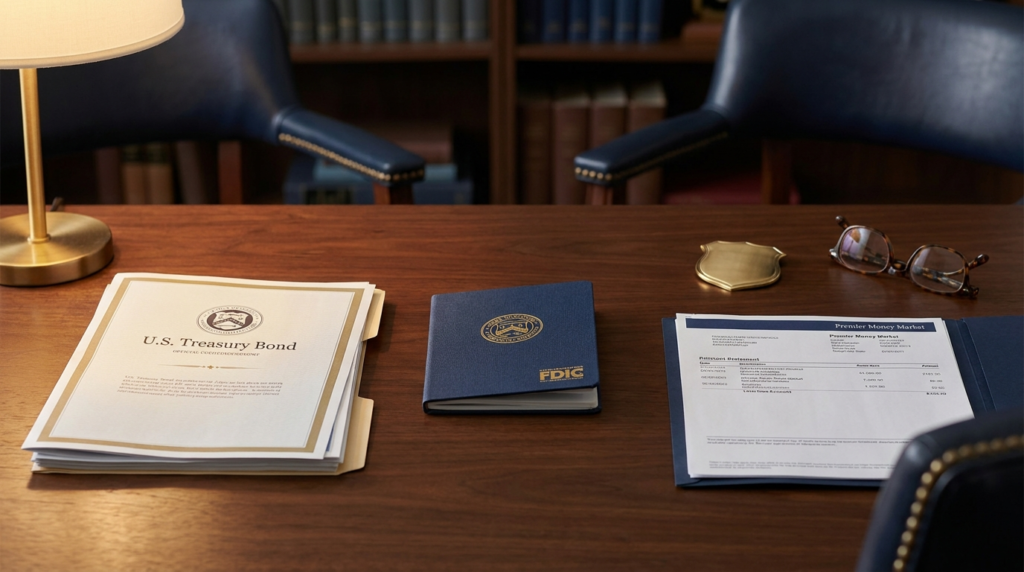
When markets get scary, a viewer summed up the instinct perfectly: “When there’s a mad dash for cash, all else is trash.” If you’re holding cash and your only goal is to not lose it — no risk, no drama — then the question is simple: what’s the safest place for cash right now? Here are the three safest homes for your money in 2026, ranked by safety, and how to choose between them.
These aren’t about getting rich. They’re about capital preservation — making sure the money is still there, intact, when you need it, while still earning a real return of around 4% instead of nothing. All three are about as close to risk-free as money gets.
1. U.S. Treasury Bills — The Safest of Them All
At the top of the safety pyramid sit U.S. Treasury bills. They’re backed by the full faith and credit of the U.S. government — the same entity that prints the dollar — with no $250,000 cap and no bank standing between you and your money. In 2026, short-term T-bills pay around 4.3%, and the interest is exempt from state and local income tax, which can make them the highest after-tax safe yield available.
For large cash balances especially, nothing beats a Treasury bill ladder for safety. Buy them directly and commission-free at TreasuryDirect.gov, or through any brokerage. This is the bedrock of any “I cannot afford to lose this” plan.
2. FDIC-Insured Savings & CDs — Safe and Simple
Next: deposit accounts at an FDIC-insured bank — high-yield savings, money market accounts, and CDs. The FDIC guarantees up to $250,000 per depositor, per bank, per ownership category, and no insured depositor has ever lost a penny since 1933.
High-yield savings pays around 4% with instant access; CDs lock in around 4.5% for a set term. The one rule: keep each ownership category under $250,000, or spread across banks and account types so every dollar stays insured. (For balances above the limit, Treasurys are often the cleaner answer — see is my money safe if a bank fails.)
3. Government Money Market Funds — Safe and Flexible
Third: money market funds that hold government securities, available at any brokerage. These aren’t FDIC-insured — an important distinction — but the government variety invests almost entirely in Treasurys and government-backed paper, making them very low risk, and they often pay a competitive yield with same-day access.
The key warning: a money market fund (at a brokerage) is not the same as a money market account (at a bank). The account is FDIC-insured; the fund is not. Government money market funds are still considered very safe and are great for cash you’re staging for investments — just know exactly what you hold.
How to Choose Between the Three
You don’t have to pick just one. A simple safety-first structure:
- Instant-access cash → high-yield savings or a government money market fund.
- The bulk of your safe money → a Treasury bill ladder (safest, tax-friendly).
- Rate you want locked → a CD or two before the Fed cuts.
That spreads your cash across the three safest options while keeping it productive. For the full step-by-step on sizing each, see where to put $100K right now.
The One Place Your Safe Cash Should NOT Be
The least safe place for “safe” cash is a big-bank checking or savings account paying 0.4%. It feels safe because the dollars don’t move — but inflation quietly erodes about 3-4% of its value every year. Safe from loss of dollars isn’t the same as safe from loss of value. Move idle cash into one of the three options above and you stay safe and keep pace.
Frequently Asked Questions
What is the safest place to put cash right now?
U.S. Treasury bills are the safest, backed directly by the U.S. government with no dollar cap and exempt from state tax. Close behind are FDIC-insured savings accounts and CDs (up to $250,000 per category) and government money market funds. All three are near risk-free and pay around 4% in 2026.
Is cash safer in Treasury bills or a bank?
For amounts above the $250,000 FDIC limit, Treasury bills are safer because they’re backed by the U.S. government with no cap and don’t depend on a bank’s solvency. Below the limit, FDIC-insured bank accounts and Treasurys are both extremely safe — Treasurys add a state-tax advantage.
Are money market funds safe?
Government money market funds are considered very safe because they hold Treasurys and government-backed securities, but they are not FDIC-insured like a bank money market account. They’re covered by SIPC against brokerage failure, not guaranteed against loss, so know whether you hold a fund or an account.
How much interest can I earn on safe cash in 2026?
Around 4% to 4.5% — high-yield savings near 4%, Treasury bills around 4.3%, and CDs around 4.5%. That’s roughly ten times the 0.4% paid by a typical big-bank account, with the same level of safety.
Where should I keep cash during a market crash?
In the safest, most liquid options: Treasury bills, FDIC-insured savings, and government money market funds. Keeping one to three years of spending in these lets you avoid selling investments at a loss during a downturn, while your cash still earns around 4%.
The Bottom Line
The safest place for cash in 2026 is a mix of the three near-risk-free options: U.S. Treasury bills at the top, FDIC-insured savings and CDs, and government money market funds. Spread your cash across them, keep each FDIC category under $250,000, and get every dollar out of the 0.4% big-bank account that’s quietly losing to inflation. Safe and earning 4% beats “safe” and losing value every time.
Build your full safe-cash plan, sized to your situation, with the TTF Blueprint.