
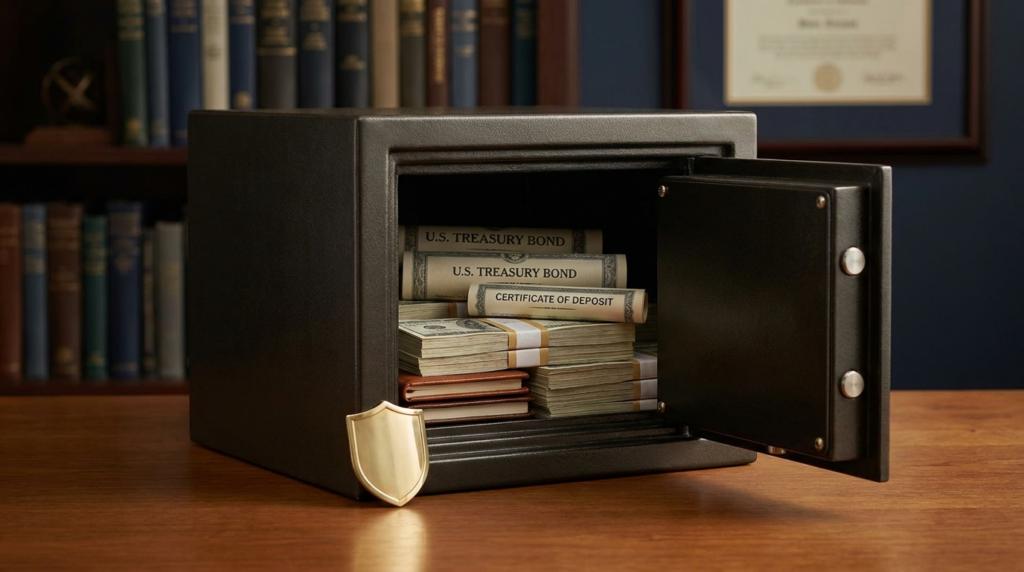
A viewer put it better than any economist ever has: “I’m so tired of speculation. I just want sound money that I can save in.” If you’ve ever felt that — if you just want a safe place to put your money that keeps its value instead of bleeding out to inflation — this is for you. The truth is, learning how to protect your savings from inflation doesn’t require gambling on crypto, stocks, or anyone’s hot take. It requires four boring, reliable tools. Here they are.
Here’s the problem in one sentence: money sitting in a regular bank account at 0.4% while prices rise 3-4% a year is guaranteed to lose purchasing power. The $20 that filled your gas tank decades ago barely buys lunch now. That’s not bad luck — it’s inflation doing exactly what it does. The fix is putting your money where it can at least keep pace.
Why “Just Saving” Isn’t Safe Anymore
For a generation, savers were told to keep cash in the bank and stay safe. But “safe” only means safe from losing dollars — not safe from losing value. If your savings earn 0.4% while inflation runs 4%, you’re losing about 3.6% of your real wealth every year, quietly, with the bank’s blessing. On $100,000, that’s roughly $3,600 of purchasing power gone annually. See exactly what inflation does to your number with the TTF inflation calculator — it’s worse than most people realize.
Sound money — money that holds its value — isn’t about chasing returns. It’s about not going backwards. These four tools do that.
Tool 1: High-Yield Savings (For Money You Touch)
Start with the cash you need access to. A high-yield savings account pays around 4% in 2026 — roughly ten times a big-bank account — and it’s FDIC-insured up to $250,000. It won’t make you rich, but at 4% against 4% inflation, you’re treading water instead of sinking. This is where your emergency fund and near-term cash belong.
Tool 2: Treasury Bills (Government-Backed, Tax-Friendly)
For money you won’t need for a few months to a year, Treasury bills pay around 4.3% in 2026, are backed by the full faith of the U.S. government, and — crucially — are exempt from state and local income tax. For a saver in a taxed state, that exemption can make a T-bill the highest after-tax safe yield available. Buy them directly and commission-free at TreasuryDirect.gov. The full step-by-step is in where to put $100K right now.
Tool 3: I Bonds & TIPS (Built to Beat Inflation by Design)
Here’s the one most people miss. I Bonds and TIPS are the only savings tools engineered to keep pace with inflation. I Bonds adjust their rate with the Consumer Price Index every six months and are state-tax-free (capped at $10,000 per person per year). TIPS adjust their principal with inflation and have no purchase cap. When inflation rises, these rise with it — that’s the whole point. For the saver whose deepest fear is rising prices eroding what they built, this is the bucket that fights back. I compared the two in detail in I Bonds vs TIPS in 2026.
Tool 4: CDs (Lock In Today’s Rates)
If you want to guarantee a rate before the Fed cuts, certificates of deposit let you lock in around 4.5% for a set term, FDIC-insured. The trade-off is access — your money is committed for the term. The smart approach is a ladder: split across 3-month, 6-month, and 12-month CDs so cash frees up regularly and you’re never fully locked when rates move.
How to Put It Together (The Simple Sound-Money Plan)
You don’t need all four in equal measure. A simple, sleep-at-night structure:
- Immediate cash → high-yield savings at ~4%.
- 1-12 month money → Treasury bill and CD ladder at ~4.3-4.5%.
- Inflation insurance → I Bonds and TIPS for the money you most want to protect.
That’s it. No speculation, no charts, no anyone’s price prediction. Just money that holds its value. The TTF Blueprint lays out the exact amounts for your situation.
Frequently Asked Questions
How do I protect my savings from inflation?
Move money out of low-rate bank accounts into tools that at least match inflation: high-yield savings (~4%), Treasury bills (~4.3%), CDs (~4.5%), and inflation-indexed I Bonds and TIPS. The last two are specifically designed to rise with inflation, making them the core of any inflation-protection plan.
Where can I keep money so it doesn’t lose value?
I Bonds and TIPS are the only common savings tools built to keep pace with inflation by design. Pair them with high-yield savings and a Treasury or CD ladder for money you need sooner. Together, these keep your purchasing power intact without market risk.
Is it safe to keep money in the bank in 2026?
Your dollars are safe in an FDIC-insured bank up to $250,000, but their value isn’t — a 0.4% account loses ground to 4% inflation every year. Move to a high-yield savings account or Treasurys so your money at least keeps pace with rising prices.
What is the safest investment that beats inflation?
I Bonds and TIPS are the safest inflation-beating options because they’re backed by the U.S. government and adjust with the Consumer Price Index. They won’t make you rich, but they reliably preserve purchasing power with virtually no risk to principal.
How much of my savings should be inflation-protected?
Keep near-term cash in high-yield savings and Treasurys, and dedicate a meaningful slice — often 20-30% of your safe money — to I Bonds and TIPS. The right amount depends on your timeline and how much of your wealth you most want shielded from rising prices.
The Bottom Line
Knowing how to protect your savings from inflation comes down to four boring, reliable tools — high-yield savings, Treasury bills, I Bonds and TIPS, and CDs — and ignoring the speculation entirely. You don’t need to gamble to keep your money’s value. You need to stop leaving it in an account that’s quietly losing 3-4% a year. That’s sound money: not exciting, just dependable.
Build your own sound-money plan, with the exact amounts for your situation, using the TTF Blueprint.
Calculate the real cost to your savings: inflation impact calculator.