
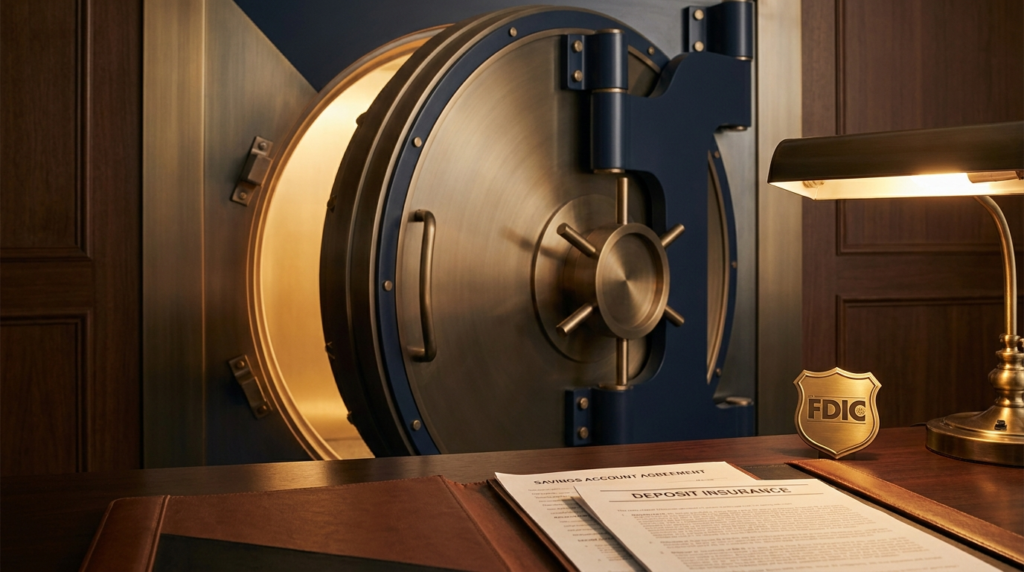
Every time a bank makes headlines, the same fear hits: is my money safe if a bank fails? The short answer is yes — if your deposits are within FDIC limits, you have never lost a penny of insured money in the history of the program, even when banks collapsed. But “within the limits” is doing a lot of work in that sentence, and that’s exactly where people get caught. Here’s how to make sure every dollar you have is actually protected.
This isn’t about panic. It’s about the calm, five-minute checkup that guarantees a bank failure can never touch your savings. Let me walk you through it.
How FDIC Insurance Actually Works
The FDIC insures deposits up to $250,000 per depositor, per insured bank, per ownership category. If an FDIC-insured bank fails, the government makes your insured deposits whole — usually within a few business days. Since the FDIC was created in 1933, no depositor has lost insured funds.
The three phrases that matter: per depositor, per bank, and per ownership category. Understand those and you can protect far more than $250,000 at a single bank — legally and simply.
How to Insure More Than $250,000 (Without Opening 10 Banks)
The $250,000 limit is per ownership category, and there are several categories. That means one couple can cover well over $1 million at a single bank:
- Your individual account: $250,000 insured.
- Your spouse’s individual account: another $250,000.
- A joint account: $250,000 per co-owner — so $500,000 on one joint account.
- Revocable trust accounts: $250,000 per beneficiary.
Stack those categories and a married couple can insure $1 million or more at one institution. If you’re holding large cash balances, this is the structure to set up before you ever worry about a headline.
The Cash That Is NOT FDIC-Insured (Most People Miss This)
Here’s where smart savers slip. FDIC insurance covers deposit accounts — checking, savings, money market deposit accounts, and CDs. It does not cover:
- Stocks, bonds, and mutual funds
- Money market mutual funds (different from money market deposit accounts)
- Annuities and life insurance
- Crypto held at an exchange
Investments held at a brokerage are instead covered by SIPC, which protects against the brokerage failing — not against your investments losing value. Know which protection applies to which dollar.
The Safest Place of All: U.S. Treasurys
If you want to step entirely outside the question of bank failure, Treasury bills and notes are backed directly by the full faith and credit of the U.S. government — no $250,000 cap, no bank in the middle. For large cash balances, a Treasury ladder is often safer and more tax-efficient than stretching FDIC categories.
I compared the safe-cash options in detail in Treasury bills vs. CDs in 2026 and where to put $100K right now — both worth reading if you’re sitting on serious cash.
Your 5-Minute Bank Safety Checkup
- Confirm your bank is FDIC-insured. Look for the FDIC sign or check the FDIC’s BankFind tool. Credit unions are covered separately by the NCUA, with the same $250,000 limit.
- Add up your balances per ownership category at each bank. Anything over $250,000 in a single category is exposed.
- Spread or restructure anything above the limit — across categories, across banks, or into Treasurys.
Frequently Asked Questions
Is my money safe if a bank fails in 2026?
Yes, if it’s within FDIC limits. The FDIC insures up to $250,000 per depositor, per bank, per ownership category, and no depositor has ever lost insured funds. Money above the limits, or in investments rather than deposits, is not FDIC-protected.
How much money is insured by the FDIC?
$250,000 per depositor, per insured bank, per ownership category. By using multiple categories — individual, joint, and trust accounts — a couple can insure $1 million or more at a single bank.
What happens to my money if my bank collapses?
The FDIC steps in, typically within a few business days, and either transfers your insured deposits to another bank or pays you directly. Insured depositors usually regain access to their money almost immediately.
Is money in a brokerage account FDIC-insured?
No. Brokerage investments are covered by SIPC, which protects against the brokerage failing, not against investment losses. Only bank deposit accounts — checking, savings, money market deposit accounts, and CDs — are FDIC-insured.
Are Treasury bills safer than bank deposits?
Treasury bills are backed directly by the U.S. government with no dollar cap, so for balances above FDIC limits they can be safer than bank deposits. They’re also exempt from state and local income tax, which is a bonus for many savers.
The Bottom Line
Stop losing sleep over the question is my money safe if a bank fails. Keep each ownership category under $250,000 at FDIC-insured banks, know that investments aren’t deposits, and move large cash balances into Treasurys when it makes sense. Do that checkup once and a bank failure becomes someone else’s problem, not yours.
Want the full plan for protecting and positioning your cash? Start with the TTF Blueprint.